

How To Install C Band Dish
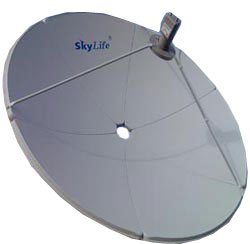
Television, radio broadcasting and Internet from satellites is carried out in 2 main ranges - C (3500-4200 Mhz) and Ku (10700-12750 Mhz). Almost antennas around the world are tuned to the Ku band. This is due to the fact that most satellites around the world broadcast in the Ku band. In the C-band, mostly Russian satellites broadcast such as Yamal (49'East, 90'E), Express-AM5 (140 E), ABS-2 (75'E). Antennas for receiving and C-band transmissions are big, therefore this range is less pop. For example, to receive the Ku band signal from the Yamal 401 90.0 � E satellite, you can use a satellite antenna with a diameter of 0.9 - 1.2 meters, and to receive the C band, from the same satellite, it is desirable to utilize an antenna of at least one.five, and preferably ane.8 - ii.0 meters However, the bespeak reception quality in the C-band is less dependent on the bear upon of meteorological atmospheric condition than in the Ku band. For case, Ku band reception is sharply degraded due to snow-covered antenna surfaces, clouds, or pelting. At the aforementioned time, reception in the C-band is possible even on a fully snow-covered antenna, without degrading the image quality.
Direct Focus Antenna
For receiving C-band signals, direct focus satellite antennas are mainly used, the diameters of which can be from 1.5 m to three.7 m For direct focus antennas, the �mirror� has a parabolic shape. Because of this, the effect of a �direct axle� is accomplished when the entire spectrum of radio waves incident on the mirror is reflected in the converter (run across the effigy beneath). 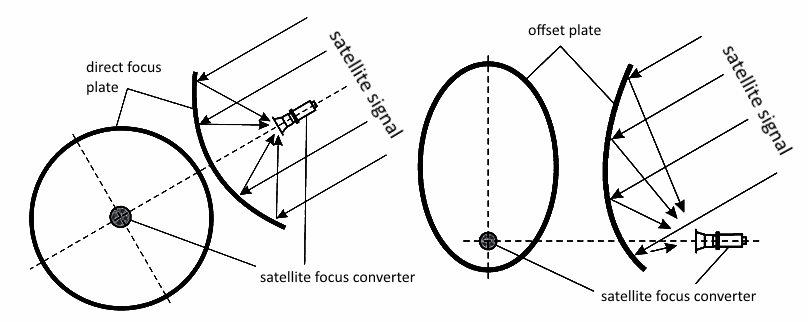
Focus lenses take their pros and cons. Since the satellite antenna converter is located in the eye, at the intersection of radio waves, it obscures the eye of the antenna. Because of this, not all waves enter the converter. Because of this, it was necessary to increase the coverage area by 1.5-two times and slightly increase the size of the emitter. Size solves another big question - the quality of reception, which offset antennas cannot boast of. The shape of the bend plays an important role: most 90% of the area is used to collect and reverberate the rays, while get-go - only seventy%.
The main disadvantage of the directly focus dish is its location. When setting, the degree from the horizon is about 15-xx% (for comparison, the offset satellite dish tin can generally stand upright or at almost 5-7%). The slope contributes to the fact that all snow, h2o, dirt and leaves constantly settle on the reflector, thereby making reception hard. Such television satellite dishes are inconvenient to mount on balconies or walls of buildings. To practice this, I would have to make a long remote subclass, which is very not convenient.

C-Ring Converters
The converter (or LNB - Low Dissonance Block) is designed to convert the frequency of the C ring (3.five - 4.ii GHz) to an intermediate frequency of 900-2150 MHz for manual with the least loss on the coaxial cable to the satellite receiver. 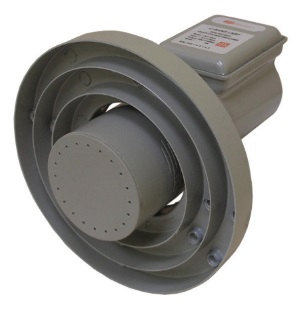
Specifications:
- Input frequency range: 3.7-4.2 GHz.
- The output frequency range is 950-1750 MHz.
- The frequency of the local oscillator 5150 MHz.
- Racket figure 17 K. Gain 65dB (Typ.).
- Control signals [V] xiii V.
- Command signals [H] 18 5.
The local oscillator frequency for the C-ring is set to 5150 MHz. For the C-band, 22 kHz is not necessary. Therefore, it�south absolutely still whether this signal will exist or not.
Polarization of converters
In addition to the frequency spectrum (range), the converters differ in the type of polarization of the point. Moreover, in one converter two types of polarization tin can be present at once. Here are two primary types of converters:
1. Linear universal satellite converter (Universal) - in this type of converter there are two types of polarization: Linear Horizontal (H - Horisontal).
Linear vertical (V - Vertical).
ii. Circular satellite converter (Round) - in this blazon of converter at that place are besides two types of polarization:
Round Right (R - Right).
Circular left (Fifty - Leftl).
Depolarizer
The depolarizer allows you to convert the circular polarization of the signal from the satellite to linear, which the converter can take with greater efficiency. Information technology is installed in linear polarization converters. Most often, a depolarizer is a dielectric plate in a converter waveguide.
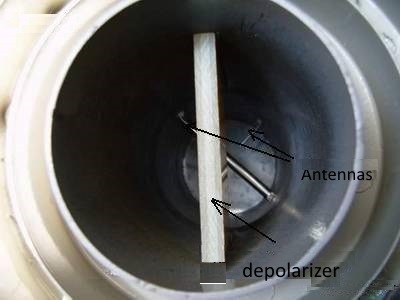
The material of the depolarizer is fluoroplastic, or, most often, fiberglass. You can use plates of light fiberglass, vi mm thick, 35 mm wide, length - according to the internal size of the irradiator pipe. It is installed after searching and capturing the signal from the satellite into the irradiator tube at a position of 45 � relative to the receiving probe (pin) in the head. If there are grooves in the waveguide for the caput, a depolarizer is inserted into them. These are not the only possible materials and the class of depolarizers, but information technology is with such depolarizers that the most stable results and the least number of adjustments.
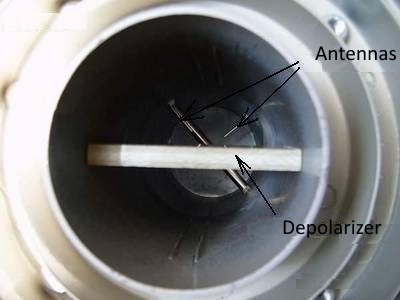
If after installing the depolarizer the betoken level has disappeared, or its level has dropped significantly - change the position of the depolarizer by ninety �, or change the polarization of the transponders in the tuner settings, vertical to horizontal and vice versa.
Notation:
Some models of C-band converters let you to increase the bespeak level with a non-standard position of the depolarizer, namely + 90 � relative to the grooves. It is determined in a practical way.
Tuning the direct focus antenna to the Yamal satellite 401 (201), xc � E
Next, we volition look at how to install and configure a 1.8 grand straight-focus segmented satellite antenna to receive a signal from the Yamal satellite - 401, 90E (xc � East). To receive a signal from the Yamal-201 satellite (90 � East), a depolarizer plate, as described higher up, must be inserted into the converter.
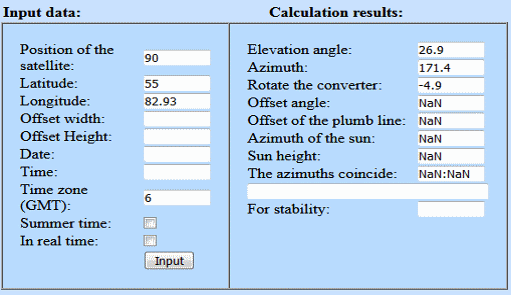
We select the installation location conditionally in such a way that the direction to the satellite � Novosibirsk � is a suitable place. The process of tuning the antenna in the C-band is not significantly dissimilar from tuning in the KU-band. To determine the coordinates of the direction to the satellite, we need to use the online estimator or another service to make up one's mind the elevation and azimuth.
First you demand to find out the geographical coordinates of your location, the name of the satellite.
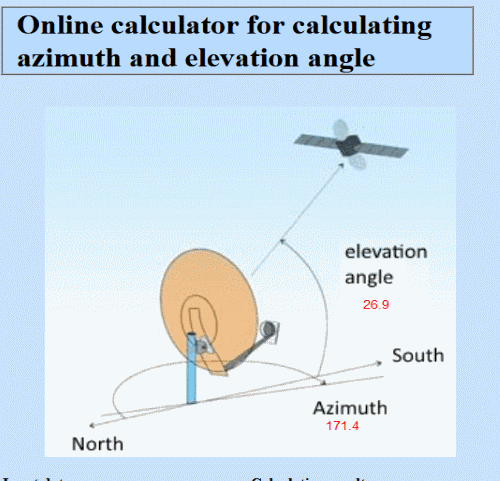
In our case, Novosibirsk:
Coordinates of Novosibirsk in decimal degrees
Breadth 55.0415
Longitude 82.9346
Substitute in the online calculator and summate
height angle: 26.9 �
bearing: 171.4 �
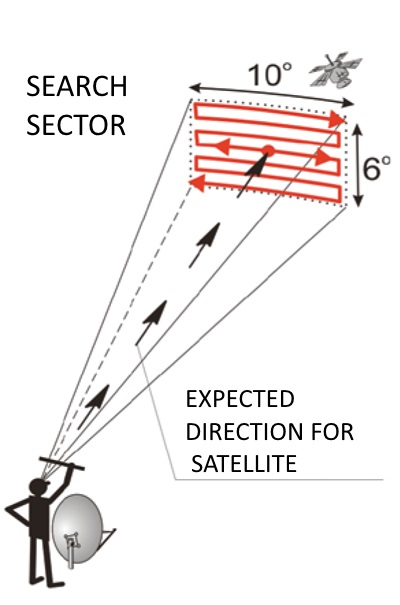
Adjacent, nosotros measure the azimuth using a compass, and the elevation angle using the goniometer as shown in the figure and go along to configure the antenna.
You tin can likewise navigate aslope continuing antennas tuned to the same satellite. In the event that there are no antennas nearby, and you do not take a sufficiently authentic compass and goniometer, y'all can navigate in the search by the sun, whose position coincides with the position of the satellite at virtually 12 noon.
Search and capture of a signal from a satellite is carried out by the about powerful transponder. In the tuner menu, the converter local oscillator frequency is gear up to 5 150 MHz. The data of the strongest transponder is prepare. On Yamal, 90 � East is the Gazkomovsky package.
Tabular array No. 1. Satellite Transponder Parameters:
| Satellite | Transponder | Channel for visual inspection |
| Yamal 401 | 3645 L 28000 | NTV (+ 7h), Match !, Shopping Live |
| 3969 L 22222 | TNT4 (+ 7h), Leomax 24 | |
| 3674 L 17500 | Spas, Radost Moya |
The circulate parameters in the tabular array are relevant at the time of writing and may change over time, so stay tuned for changes in the parameters in the table of frequencies and transponders. The setting is made according to the menu item "Indicate strength" (Scan, etc.). Modern receivers usually accept 2 measurement scales.
First scale - "Level (Signal)" - shows the level of the inverter at the tuner input.
Second - "Quality" - shows the level of the useful signal with the given parameters (frequency, speed and FEC).
The level on the first scale includes both a useful bespeak from the satellite, and caput noises, broadcast noises, the racket of all devices on the manner from the head to the tuner. Virtually ofttimes, earlier connecting the head, the level is "0" and becomes greater than zero when it is connected.
The initial search is carried out on the kickoff scale. The level on it increases as you approach the satellite. The search is carried out by scanning the sector in which the satellite is supposed to be. It should be borne in mind that obstacles, such as a tree, a sun structure, also increase the signal level on the first scale. But through them information technology will be impossible to receive a satellite. When the tuner picks upward a betoken from the satellite, a level appears on the second scale - "Quality". Further tuning is carried out on a second calibration to the maximum signal, the more than per centum the better.
After tuning to the maximum signal, a depolarizer is inserted, its position is adjusted and proceed to Alignment. It should besides exist taken into account that the graduation of scales is unlike both on tuners of different manufacturers, and so often on different models of the aforementioned manufacturer. Therefore, it is wrong to compare percentages of �Quality� of ii different models of tuners.
Fine tuning or adjustment is carried out by adjusting the position of the irradiator tube, its rotation, the position of the depolarizer, fine-tuning the direction of the antenna itself. All manipulations are performed in a circle a couple of times until the maximum signal is reached. After that, all other transponders are scanned into the tuner. After that, level command is performed on all channels. In the instance of a low level on weak transponders, the antenna is adjusted once more, already according to the level of weak channels.
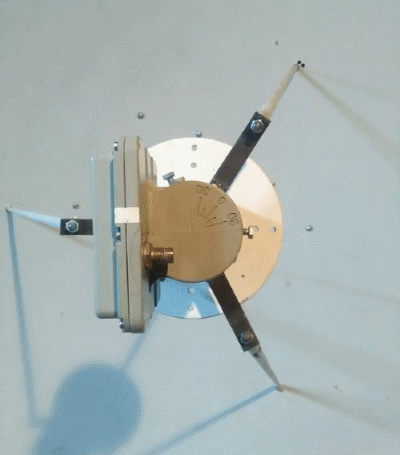
The scale at the end of the converter does not affair much, but simplified - if the satellite is in the south, and so 0 - to the world, the more to the east - right (by the hr) to thirty, to the west, respectively, to the left to 30. I adhere the irradiator with the converter to the extreme points, so that in the course of setting past turning the irradiator (for and against the hour) to detect the maximum signal (changing focus).
Relish watching!

Source: https://sattvinfo.net/ystanovka.php?yst=install_ciband&lang=en
Posted by: haskinsneard1957.blogspot.com
0 Response to "How To Install C Band Dish"
Post a Comment