

Up close with Nvidia’s Dynamic Boost feature for gaming laptops - haskinsneard1957
The future of gaming laptops, it seems, is largely focused roughly managing the limited thermal budgets between the two hottest components: The CPU and GPU. AMD has SmartShift and Intel has Dynamical Power Share, only both technologies are designed to figure out exclusively with their own hardware. Now Nvidia's joined the party with its possess Dynamic Boost, which aims to leverage the "unused" thermal budget in a laptop computer.
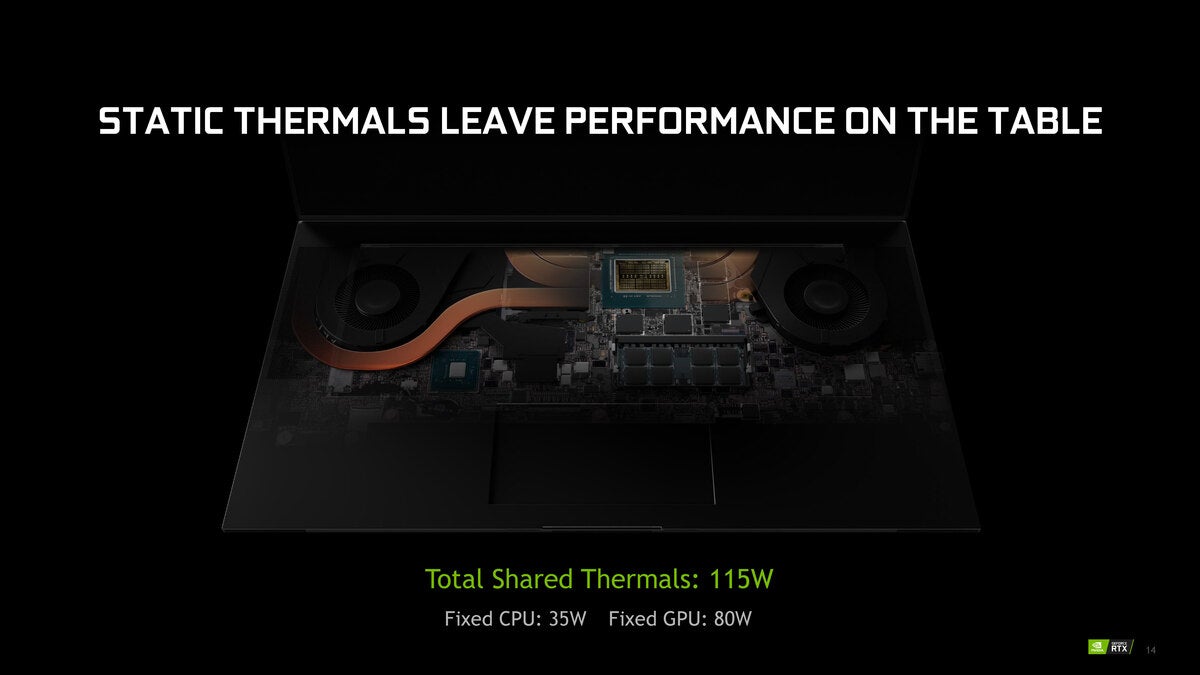
For illustration, if a laptop has a hot budget of 115 watts with 35 Isaac Watts for the CPU, and 80 watts for GPU—why not take any additional power the CPU ISN't victimisation to increase performance when gaming?
That's the idea fanny Nvidia's answer to AMD's SmartShift and Intel's Mechanics Power Share. How it works the society isn't detailing, but it is limited to DirectX gambling right hand now. We'd guess Nvidia has created algorithms to dynamically jack the GPU's exponent usance low-level certain loads, and dynamically gate the CPU's performance relevant where it doesn't injure the frame rate functioning.
 Nvidia
 Primitively, information technology was thought the feature would only be brought to the GeForce RTX 2070 Super and GeForce RTX 2080 Super announced in the beginning this year. Nvidia tells us it can Be supported on any Turing-supported laptop computer—but it's up to the laptop Jehovah to implement IT. The laptop computer should also be built around a shared hot up pipe design, because dedicated heat pipes would mean there's none point to try to share.
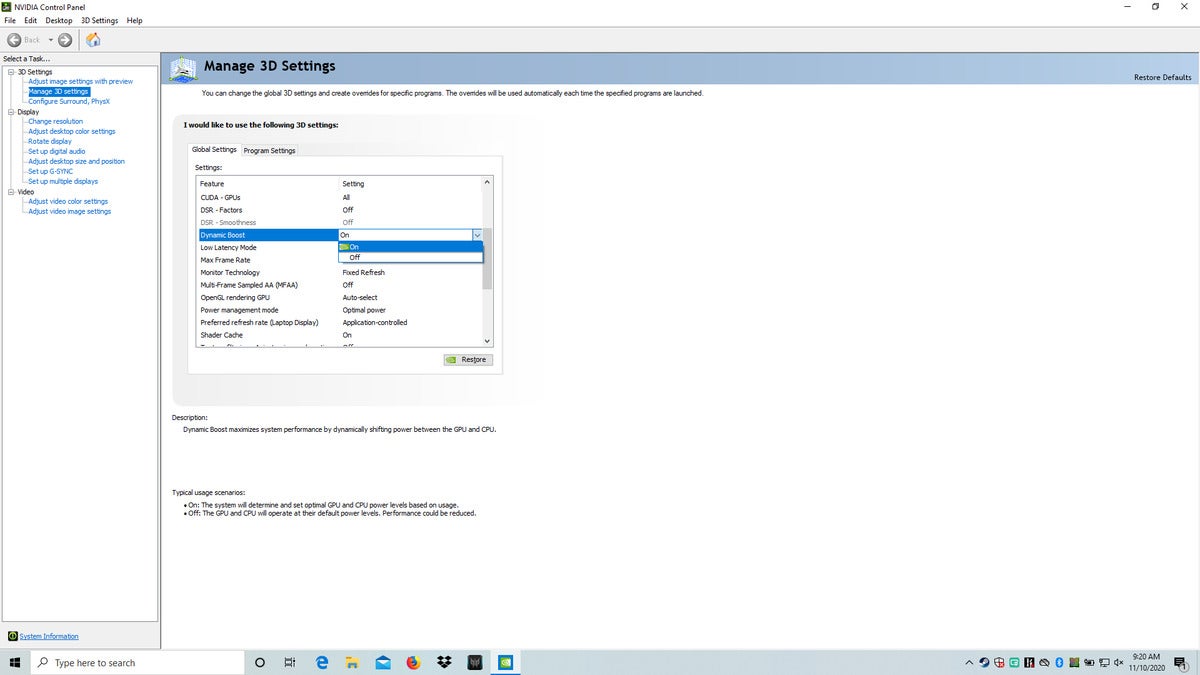
We lately got a bump to see how just healthy it works on an Acer Predator Newt 500 configured with an Intel Core i7-10750H and GeForce RTX 2080 Super. The feature is connected by default, but you can bend IT on or cancelled inside the Nvidia control panel. You can set IT globally, and as an option to trigger connected Beaver State off for particular applications as well.
 IDG
IDG To try Dynamic Promote, we ran the laptop in its default cooling visibility but soured off G-sync (which can make benchmark results a little batty sometimes) and also set the laptop to forever receive the discrete GPU on. The laptop features a mutual heat pipe design and at 18mm loggerheaded, making information technology the poster child for a shared boost technology.
 Genus Acer
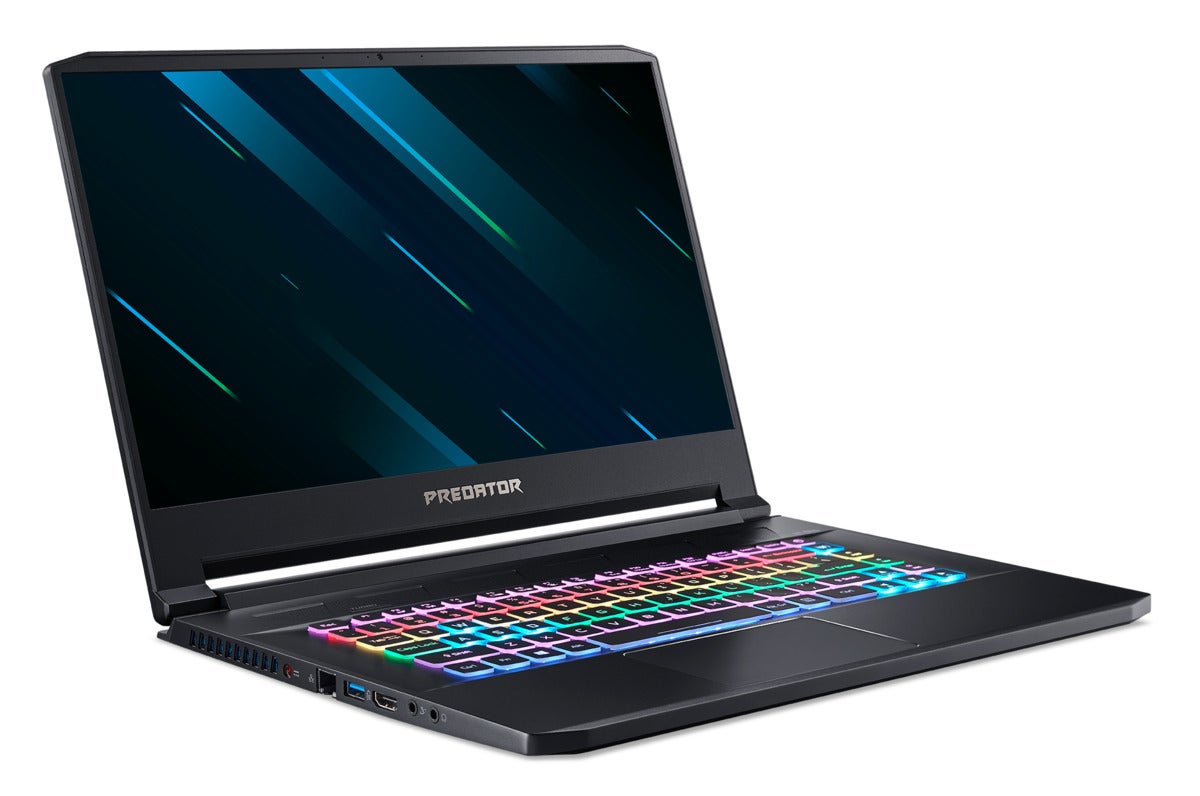
 We used an Acer Predator Triton 500 with 6-core group Core i7-10750H and Nvidia GeForce RTX 2080 Fantastic Scoop-Q inside of it to look at the Dynamic Encouragement feature.
Dynamic Boost Gambling Results
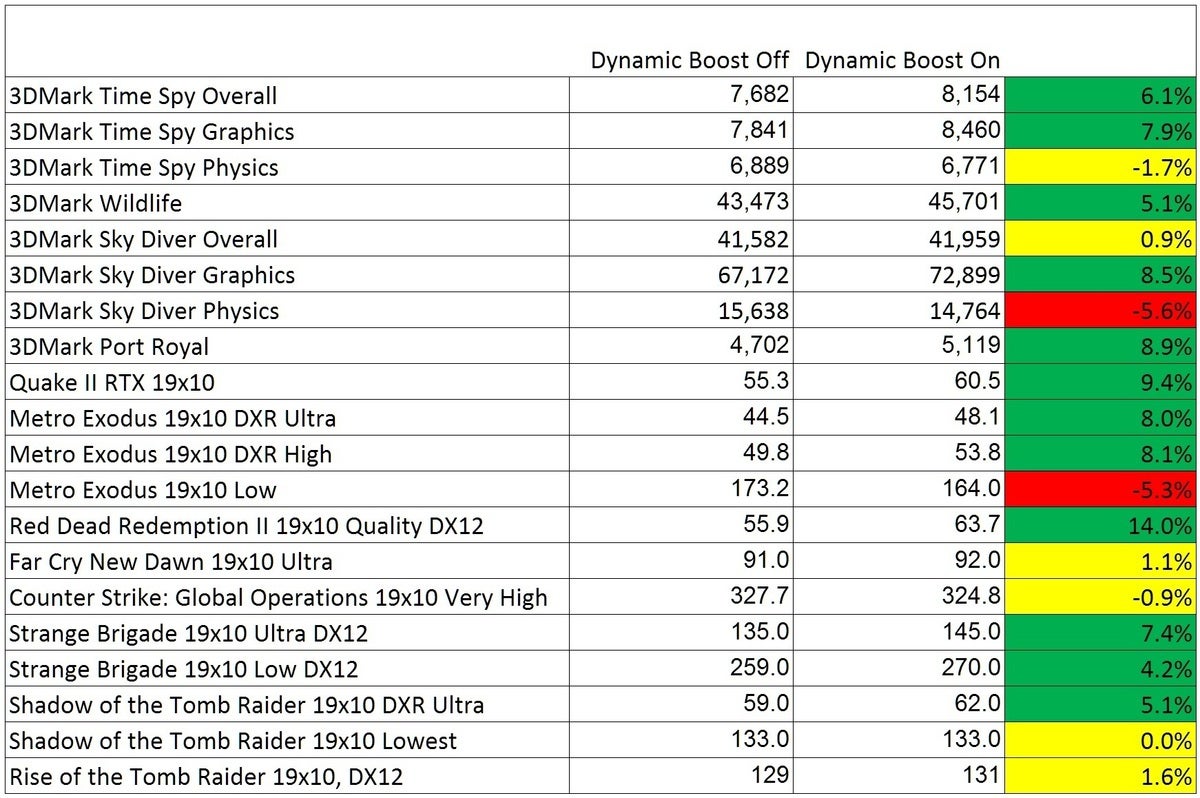
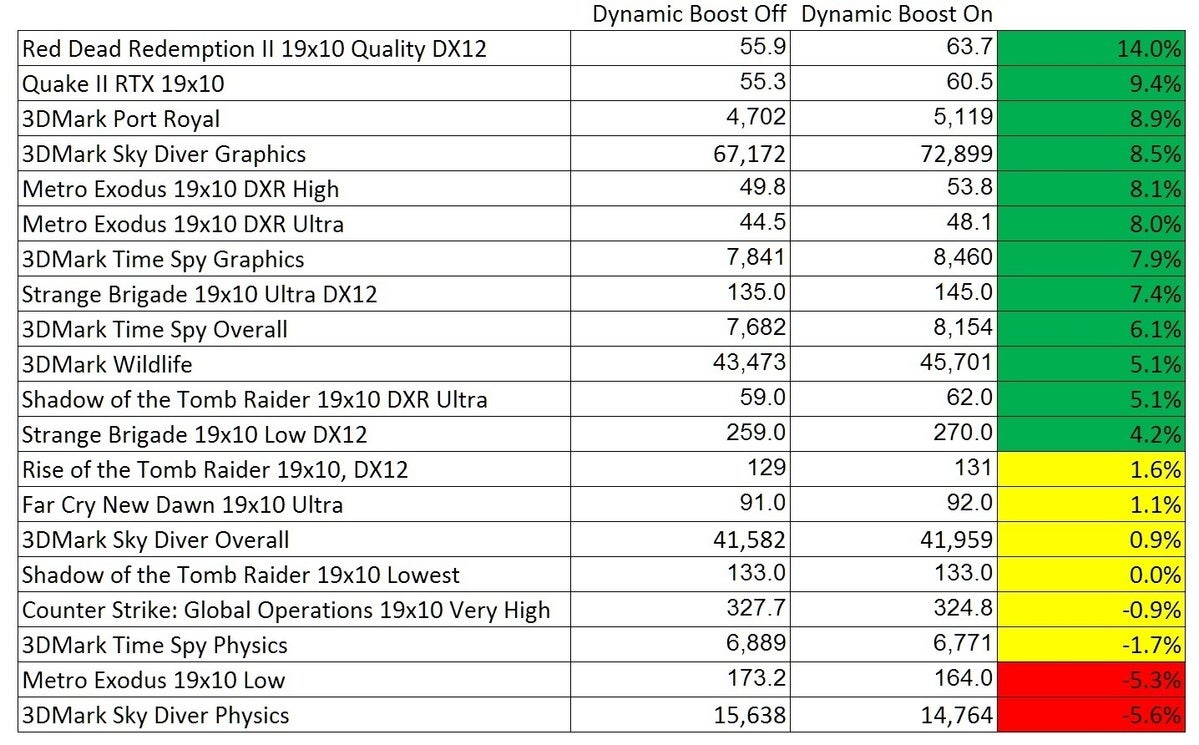
To test Self-propelled Encouragement we ran the Predator Triton 500 through multiple games too as a few synthetic graphics tests. We typically saw performance increases from 5 percent to 9 percent, which is inl wrinkle with Nvidia's previous claims about Dynamic Boost. We've highlighted the percentage exchange in dark-green for performance boosts we consider worthwhile, yellow for results that probably fall within the perimeter of error, and red for decreases in performance. Yes, we same lessen, merely you'll have to await a trifle longer to see why.
Looking at the synthetics low gear, you get a tasting for where High-voltage Boost is practical the most. 3DMark's Port Royal, for example, is a ray trace benchmark that's specially intensive for GPUs. There we see a 9.4-percent advantage with Dynamic Boost.
 IDG
IDG Nvidia's Dynamic Boost feature article works best on very diagrammatically bad play slews.
When we step binding to 3DMark's Clock Spy, we stool see a 7.9-percent increase in functioning on the graphics side but a slight decrease in the physics. Why? 3DMark is benchmark created to mensurate 3D gaming carrying into action, breaking down its tests into graphics and then a physical science test. Each test uses the CPU, of course, but the marking is constructed to brush off CPU performance for the nontextual matter portion only score IT higher for the physics test.
While Time Spy isn't every bit harsh equally Port Royal, it's still a fairly heavy graphics psychometric test. You can't suppose the same for 3DMark Sky Diver. Sky Diver is ilk Time Spy with both a graphics mental test, and a physical science test. Simply unlike Time Sleuth, it's made to see how cured a laptop with coeducational graphics can play out games. In its graphics test, we actually see a fairly decent 8.5-percent boost but the natural philosophy test actually sees its score driblet by 6.6 pct.
Nvidia said it was unable to reproduce our results, but we suspicious Dynamic Boost's clinch on the CPU's was just enough to cause a come by Sky Diver's Physics quiz.
The harsher the load, the amend Dynamic Boost industrial plant
Games Don River't typically work like a synthetic screen. The CPU and GPU behavior is affected by a stew of unknowns that is inclined to change. Even, we do see a similar pattern as 3DMark's where games that are largely bottlenecked by GPU performance seem to hit the most.
For example, the fully track traced Quake II RTX gives us a 9.4-percentage increase with Dynamic Boost connected. Metro Hegira with its DirectX Electron beam Tracing support flipped on gives us 8 percent. Rum Brigade coughs up 7.4 pct with other games, so much arsenic Shadow of the Grave Raider, giving us "simply" 5 per centum gains.
Again, Nvidia doesn't say how Kinetic Boost deeds, but the results suggest that the gains are fastened to just how much a gamey leans on the GPU performance and CPU performance. Sometimes, both privy equal fairly stable, such asFar Blazon out New Dawn and Rise of the Grave Raider.
We tried to look into that by using the same game set to its maximum image quality and its lowest image quality settings. The results mostly duplicate up.
Strange Brigade on its highest setting yields about 7.4 per centum, but set IT to its last graphics setting which should make the game inferior reliant on the GPU, we saw the carrying out increase drop curtain to 4.2 percent.
We also saw that with Apparition of the Tomb Despoiler, which "only" gives us 5.1 percent connected its highest setting using DXR—but on its lowest setting, performance is basically the same with Can-do Hike up.
We ascertain the same thing with Metro Exodus, just in unmatched of the a couple of cases, performance goes from an 8 per centum-increase to 5-per centum decrease. We're again going from a heavy, heavy GPU load with ray traced global illumination and frame in rates in the 50-fps range, to frame rates in the 160 to 170 range with the game at to its lowest prize setting. Nvidia officials said they were looking into this one decrease in performance but when the GPU isn't the bottleneck, you're now more at the clemency of the CPU's further clocks which just might throw everything nonfunctional on occasion.
This ISN't a deal breaker to us, because it was the one rubric that exhibited IT. We also think few will play a game that showcases all of the advanced graphics bells and whistles with them turned off. And as we said, even games that you would play at high frame rates didn't lose public presentation. The CPU-heavy Counter Strike: Global Operations was within the margin of erroneous belief and didn't increase anything from boosting the GPU's clock speeds. 1 leave we do want to show is forRed Suddenly Repurchase Deuce. The game exhibited a pretty huge increment of 14 percentage past switching on Dynamic Boost.
While our results are echt, Nvidia hasn't claimed duple-digit performance increase at all. Our 14-percent increase might come from running the game using the DirectX12 API kind of than using the Vulkan API which the game defaults to. Basically Don River't anticipate that huge of a gain most of the time.
Finally, we sorted our results from the C. H. Best gains to the pessimum. This makes it easier to see that the more than graphically intense the load is, the more performance you get.
 IDG
IDG Sorted by performance gains, you can see that Dyanmic Boost operation gains in the main skews toward graphics-heavy settings with results diminishing arsenic you get to hoy lots.
Here's how Energizing Boost looks
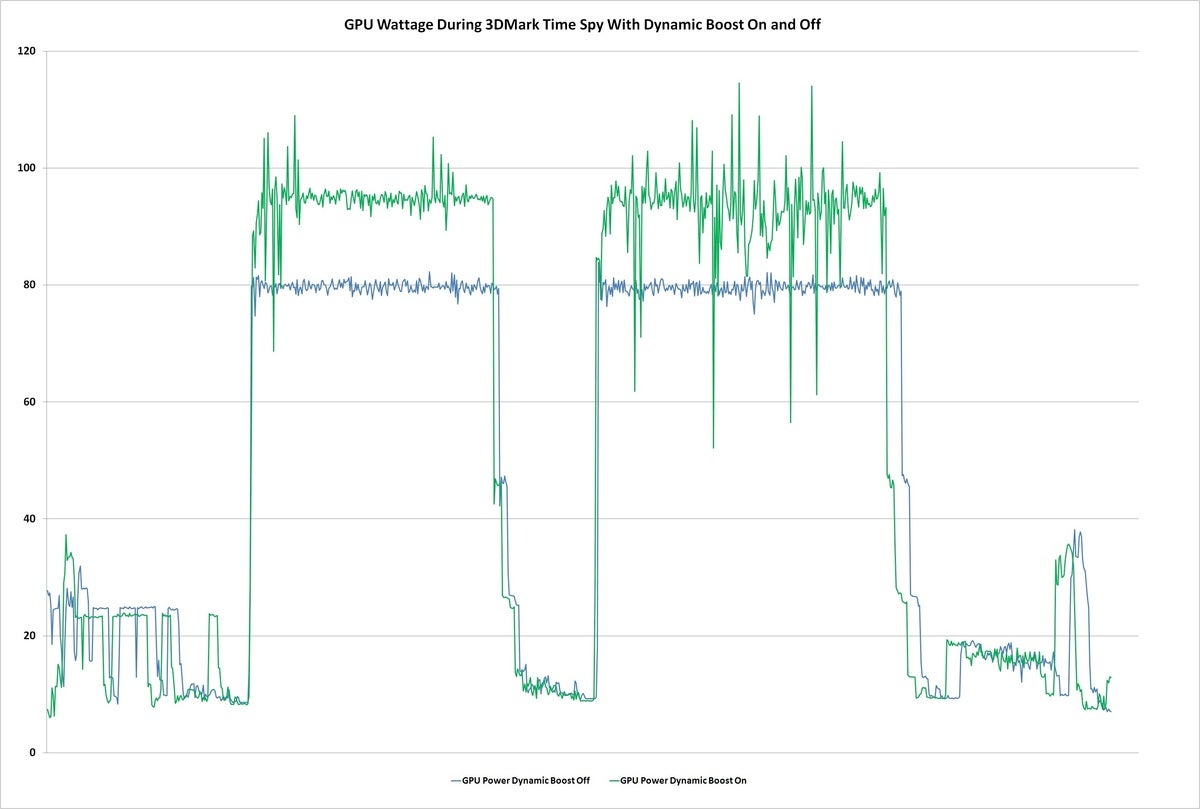
Nvidia has said Moral force Boost increases the GPU thermal budget by 15 watts, and that looks to mostly be true. We used HWInfo to log GPU and CPU during runs to see if that was occurring or not. Below you can see a 3Dmark Time Spy run you said it much wattage is exhausted by the graphics chip. The first hump is during the graphics portion, with the instant portion showing the physics portion of the test. The blue is the electric power the GeForce RTX 2080 Super Max-Q uses on the Piranha Triton 500 with Dynamic Boost off, while green is with Dynamic Boost on.
 IDG
IDG You give the sack see with Projectile Boost on that the GeForce RTX 2080 power economic consumption goes from 80 watts to 95 watts.
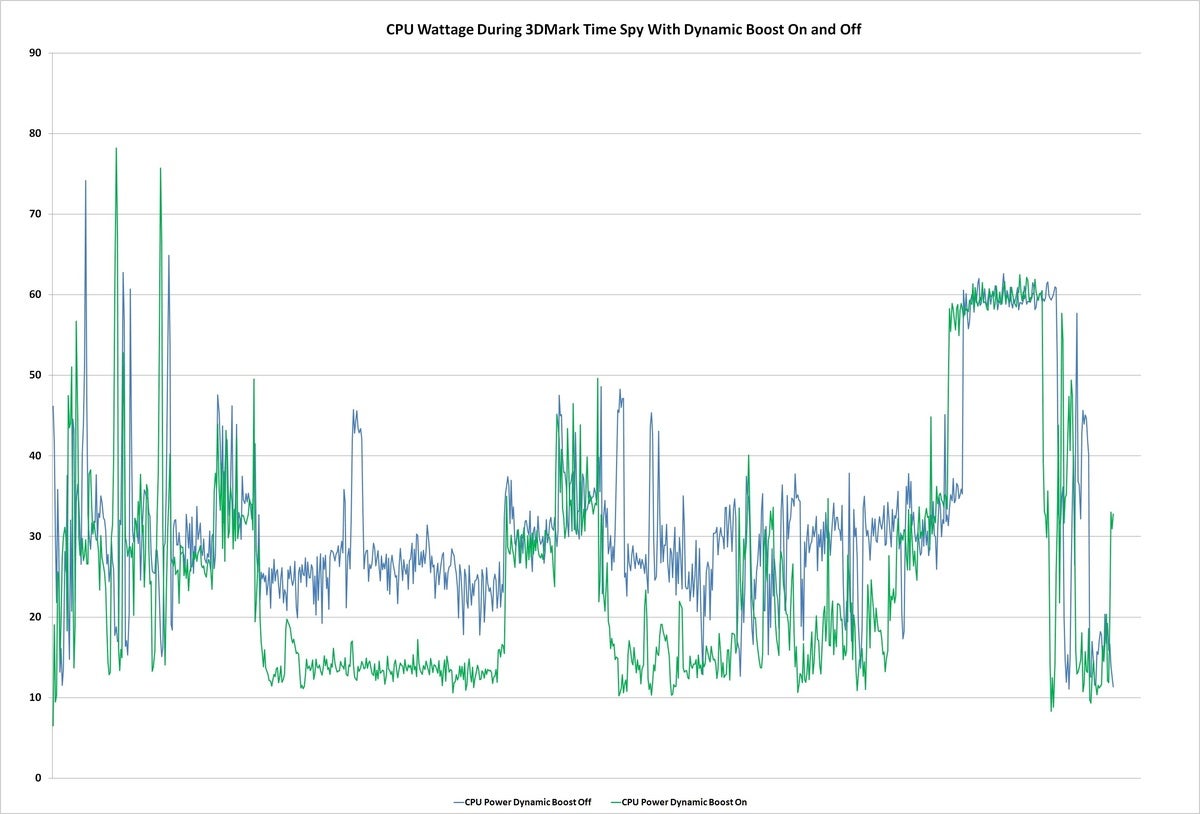
Looking at the wattage of the CPU during the unvaried 3DMark run you bum see the CPU's mogul consumption in blue is indeed lowered from the mid 20s to the underslung teens during the nontextual matter portion of the test. Its might budget is also reduced during the physics try.
 IDG
IDG You can go out the CPU's power use is reduced with Nvidia's Energising Encourage on (green) versus when it's off (blue).
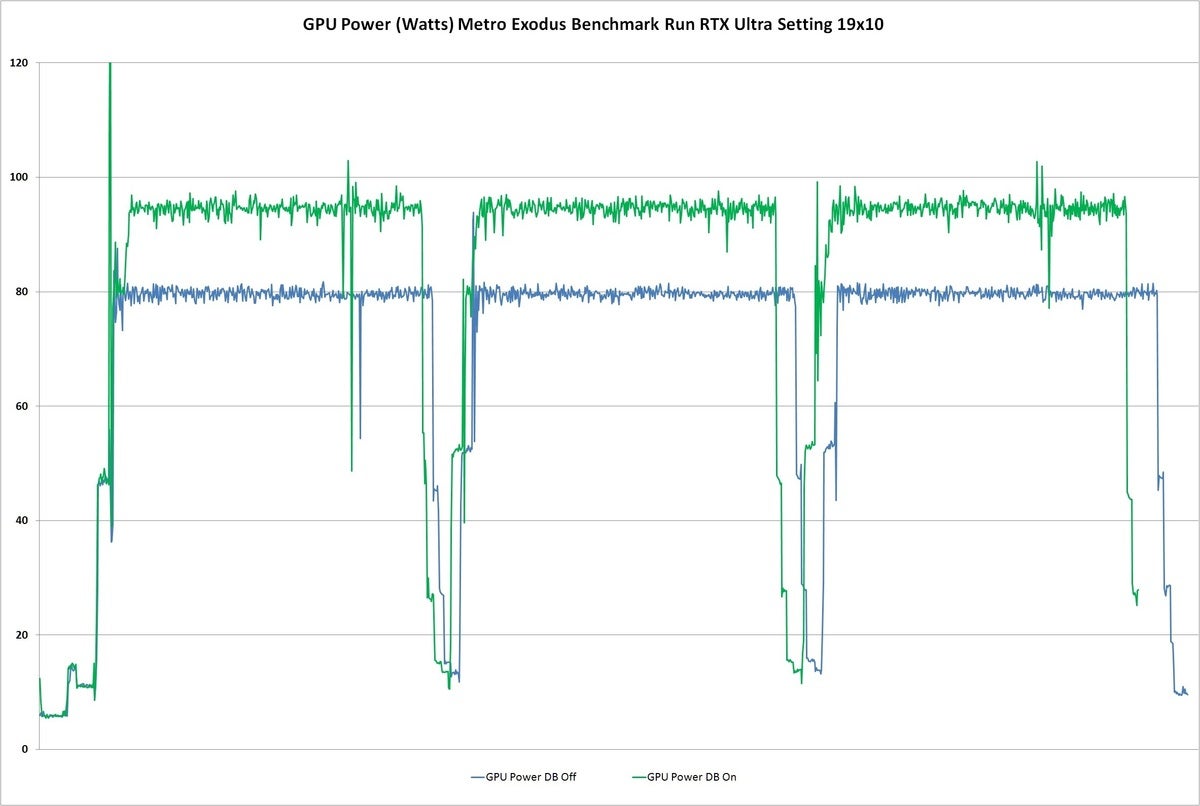
We besides wanted to deal GPU power during a gaming guide so we likewise recorded information technology during Metro Exodus with the re tracing features overturned on. You can see that IT mostly matches 3DMark, with the GPU given 15 watts more during the three identifiable runs of the inbuilt benchmark in Tube.
 IDG
IDG Dynamic Boost on (immature) vs. Dynamic Boost off (blue)
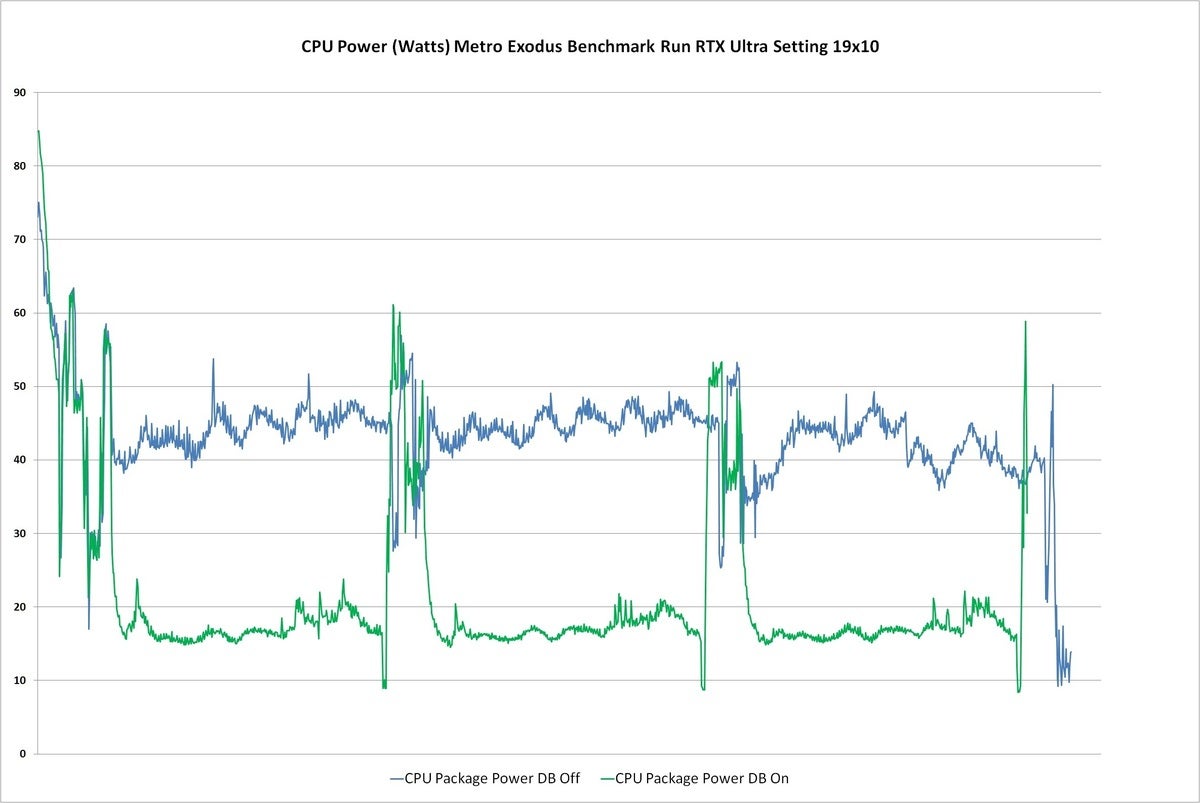
Moving on to the CPU, we can see that the CPU's is running with a budget of just under 20 watts with Dynamic Boost on. With Dynamic Further off, the Central processor would use about 45 watts of the outpouring budget.
 IDG
IDG Dynamic Encourage on during Metro Exodus gates the Processor's to nether 20 watts instead of 45 watts.
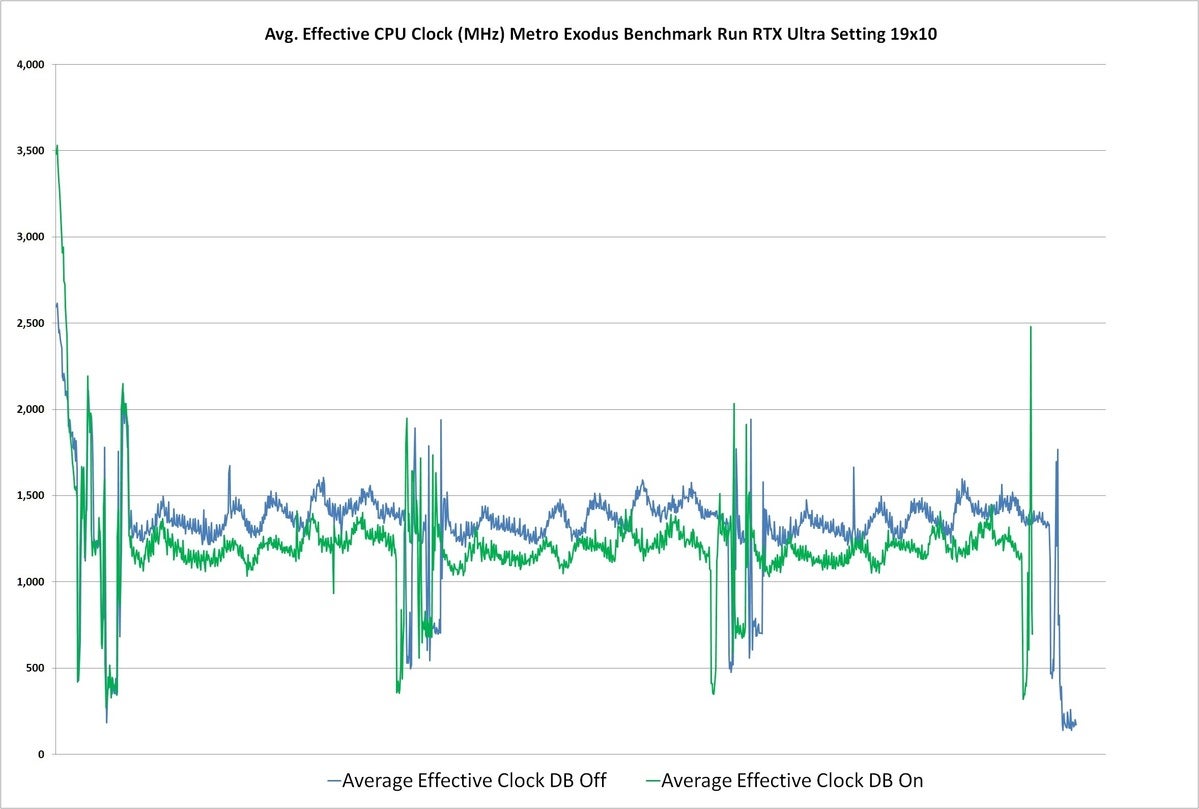
To see how such clock stop number the CPU lost while limited to low-level 20 Isaac Watts, we looked at that with Dynamic Boost along and off. Below you can view where the CPU's clock speed takes maybe a 100MHz hit throughout the three benchmark runs.
 IDG
IDG The CPU runs at a slightly slower clock swiftness when Dynamic Boost is on.
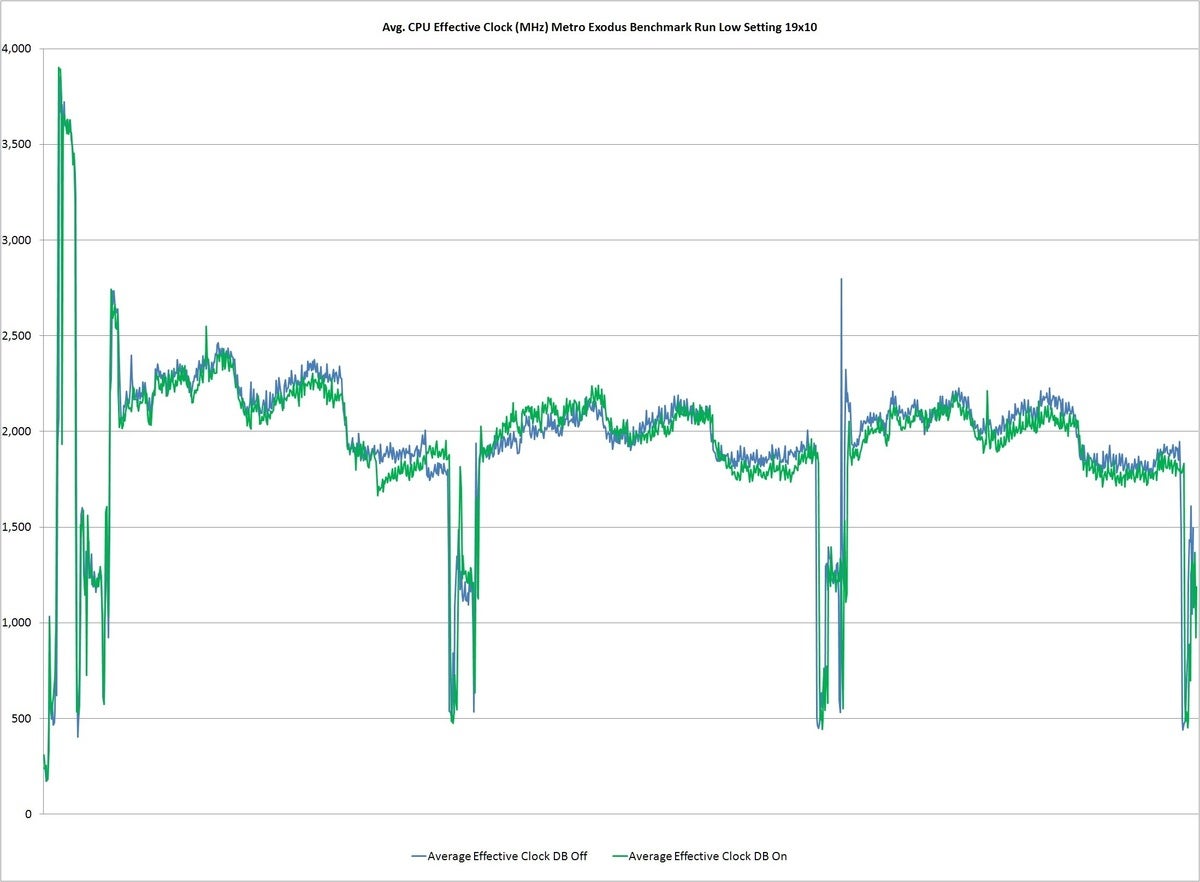
Getting back to our previous discourse just what happens when you crank a game from its near intensive graphics settings to its lowest, we did that for Metro. Comparing IT to the Metro run with altogether the bells and whistles on, the crushed place setting shifts Thomas More of the charge to the CPU.The clock speeds are very close overall, but you can see the second and thirdly humps representing the 2nd and 3rd runs are at a lower clock belt along. The time speeds end-to-end the runs are also finisher to about 2GHz, which is about 600MHz to 700MHz higher than when the game is mostly GPU.
 IDG
IDG Go under to its low setting, Underground sees the Central processor running at untold higher clock speeds.
Conclusion
Leaving forward, Nvidia bequeath find itself jostling for attention 'tween AMD and Intel, arsenic some rivals offer copyrighted power joint routines likely closed off to Nvidia. AMD's own SmartShift also promises single-digit functioning gains, and we've seen that in any of the examination we've done (Our long overdue look at SmartShift is in the whole works.)
While AMD is prospective to squeeze Nvidia on the middle-array and up (we'd imagine with peregrine parts settled on its RDNA2), Intel is expected to squeeze Nvidia on the entry degree with its own Dynamic Power Share with Xe Max GPUs and 11th-gen CPUs.
Through this optical prism, we can say that Dynamic Boost is overall pretty impressive nonetheless. Using what looks like mostly software technology, Nvidia is capable to squeeze very serious carrying out gains even though information technology lacks the keys to control the Mainframe atomic number 3 deeply as AMD or Intel would.
What the saucy-loose-sharing human race looks like in 12 months, though, is anyone's guess.
Source: https://www.pcworld.com/article/393737/up-close-with-nvidias-dynamic-boost-feature-for-gaming-laptops.html
Posted by: haskinsneard1957.blogspot.com
0 Response to "Up close with Nvidia’s Dynamic Boost feature for gaming laptops - haskinsneard1957"
Post a Comment